
Tactile Sensing

Tactile sensing is a major frontier that enables robotic systems to react quickly and meaningfully to touch. We develop modalities for tactile sensing that enable new methods of perception and control for real-world systems.
Thus far, our published work explored how suction flow rate measurements can be used to sense contact, in a way that is both remote from the end-effector and inexpensive. We’ve shown that this novel sensing modality is useful for industrial-style smart suction cup gripping in air and for underwater systems.
Continuing efforts:
- The design and control of tactile sensors for industrial applications, with physical resilience as well as meaningful signals.
- Exploring new remote tactile sensing modalities for marine and planetary tactile sensing.
Recent work published in ArXiv demonstrates how a simple change, like using stiffer polyurethane rubber instead of soft silicone, dramatically improves the physical reliability and survivability of vision-based tactile sensors. This work introduces the materials used to fabricate these sensors, as well as some methods for testing both physical resilience alongside a model-free approach to sensitivity. These methods aim to make tactile sensing something that can be both informative for grasp planners, and reliable enough to count on during experimental work and rough/heavy applications.
Benchmarking Resilience and Sensitivity of Polyurethane-based Vision-Based Tactile Sensors

The polyurethane-based VLSB delivers reliable performance without damage on heavy and rough objects that would typically break silicone VLSB designs.
Resonant Pneumatic Tactile Sensing for Soft Grippers
This “singing” tactile sensor uses resonant chambers. The electronics-free soft gripper only needs a single offboard microphone to sense grasp state. Great option for harsh environments, where electronics must be protected.
This work achieved an array of AcousTac taxels, published in Soft Robotics.
AcousTac: Tactile sensing with pneumatic-driven acoustic resonance for electronics-free soft skin
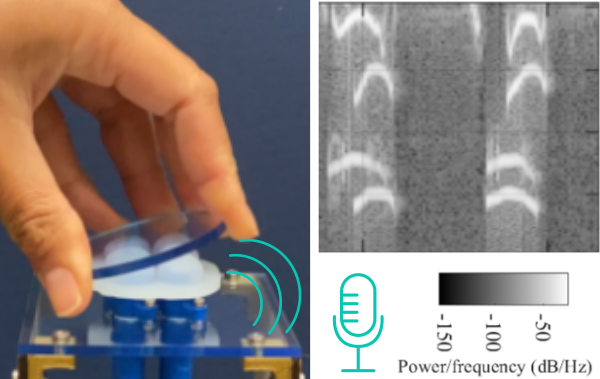
We are also seeking to make this technology smaller and higher-pitched. Relevant preliminary work published at:
Milli-scale AcousTac sensing using soft Helmholtz resonators
Fast in-hand slip control on unfeatured objects with programmable tactile sensing
We’ve shown that a capacitive slip sensor can be used to estimate fast in-hand slip motions, even when the surface does not have a detectable surface texture or geometry.